
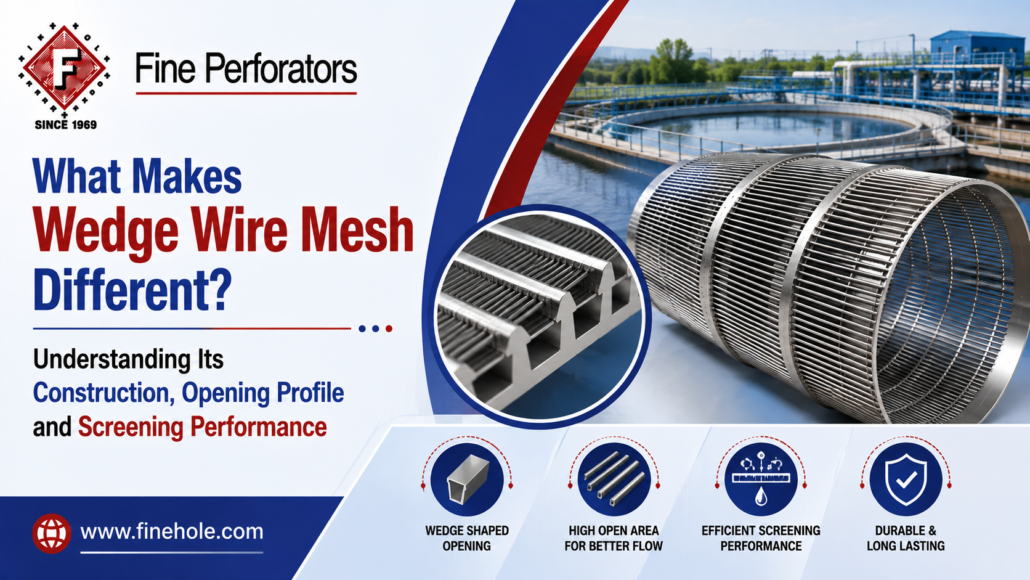
What Makes Wedge Wire Mesh Different? Understanding Its Construction, Opening Profile and Screening Performance
Wedge wire mesh is a specialized screening surface designed for applications where accurate separation, efficient flow, and resistance to clogging are important. Unlike conventional woven wire mesh, it is manufactured using profile wires and support rods that are joined together to form continuous slots. This construction gives wedge wire screens their distinctive performance characteristics in filtration, dewatering, sizing, and separation applications.
Understanding how wedge wire mesh is constructed and how its opening profile works can help industries select the right screen for their process requirements.
How Is Wedge Wire Mesh Constructed?
A typical wedge wire screen consists of parallel support rods and V-shaped or wedge-shaped profile wires. These wires are positioned at a specific distance from one another and welded to the support rods, creating a rigid screening surface. Unlike woven mesh, there are no interlaced wire intersections across the screening surface.
The wire profile, support rod arrangement, material, and slot spacing can be adjusted according to the application. This makes wedge wire screens suitable for different shapes and configurations, including flat panels, cylindrical screens, baskets, and curved screening surfaces.
The all-welded construction also provides mechanical strength and dimensional stability, which are important in continuous industrial operations involving pressure, vibration, abrasion, or heavy material loads.
Why Does the Wedge-Shaped Opening Matter?
One of the most important features of a wedge wire screen is its opening profile. The narrowest part of the slot is generally located at the screening surface, while the opening becomes wider underneath. This creates a continuous slot that allows particles and fluids to pass through more efficiently.
This geometry can help reduce the tendency of particles to become lodged inside the openings. In conventional screens, particles close to the aperture size may become trapped and gradually block the screening surface. The expanding profile of wedge wire openings helps minimize this type of blockage, making the design useful for processes where maintaining consistent flow is important.
How Does Wedge Wire Screen Improve Screening Performance?
The construction and opening profile of wedge wire mesh influence several aspects of screening performance.
Consistent slot openings: Precisely controlled slot spacing provides uniform separation and helps maintain predictable screening results.
High open area: Continuous slots can provide a substantial effective flow area, supporting higher liquid or air throughput while maintaining a strong screening structure.
Reduced clogging: The widening slot profile reduces the likelihood of near-size particles becoming permanently lodged within the opening.
Smooth screening surface: The welded profile-wire construction creates a relatively smooth surface, which can support material flow and reduce unnecessary turbulence in liquid applications.
Structural strength: Welding the profile wires to support rods produces a rigid screen capable of handling demanding operating conditions.
Where Are Wedge Wire Screens Used?
Because of their combination of strength, precise openings, and flow characteristics, wedge wire screens are used across a variety of industrial processes. Common applications include water and wastewater treatment, mineral processing, food processing, pulp and paper operations, dewatering, media retention, sizing, and liquid-solid separation.
The screen can be designed for different process requirements by changing the slot opening, profile wire dimensions, support configuration, and material grade. Stainless steel is frequently selected for applications requiring resistance to corrosion and wear, although the appropriate material depends on the operating environment.
What About Wedge Wire Screen Aluminium?
The term wedge wire screen aluminium generally refers to wedge wire screening components manufactured using aluminium or aluminium-based construction where the application calls for a lightweight material. However, material selection should not be based on weight alone. Factors such as corrosion exposure, temperature, mechanical loading, abrasion, and chemical compatibility should be considered before choosing the screen material.
For demanding industrial filtration and screening applications, the wedge wire screen filter design and material grade should be matched carefully with the process conditions.
Choosing the Right Wedge Wire Screen
Selecting a wedge wire screen involves more than choosing a slot size. The required separation, flow rate, particle characteristics, pressure conditions, temperature, corrosion exposure, and mechanical load all influence the appropriate design. Slot size and profile geometry can directly affect filtration efficiency, pressure loss, and operating life.
A reliable wedge wire screen company can help determine suitable wire profiles, slot openings, support rods, and material specifications according to the intended application.
In short, wedge wire mesh stands apart because its welded construction and expanding slot geometry combine precise screening with strength, flow efficiency, and reduced clogging. These characteristics make it a practical option for industrial filtration, separation, dewatering, and sizing where consistent performance is essential.
Leave a Reply
Want to join the discussion?Feel free to contribute!